Downloadable Files
You can download 60 Plaster and Concrete Base Materials for free from the end of this page.
60 Plaster and Concrete Base Materials
Creating convincing walls, architectural surfaces, floors, and environment assets often comes down to one important detail: the material. Even a well-modeled 3D object can feel unfinished when its surface lacks believable roughness, depth, variation, and small imperfections.
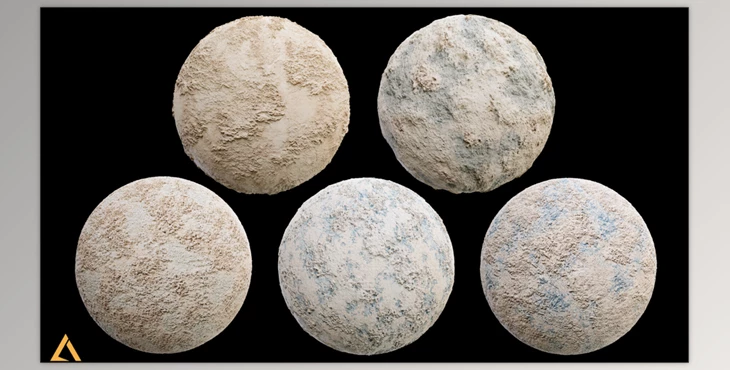
60 Plaster and Concrete Base Materials is a collection designed to make this part of the workflow easier. It provides 60 high-quality plaster and concrete materials in both customizable SBSAR format and ready-to-use 4K PBR textures.
Whether you are building an architectural scene, a game environment, a weathered wall, or a detailed 3D asset, the collection gives you a flexible starting point without requiring every surface material to be created from scratch.
Why Plaster and Concrete Materials Matter
Concrete and plaster may appear simple at first, but realistic versions of these surfaces contain many subtle details.
Small variations in roughness, uneven surface depth, pores, bumps, color changes, and imperfections can significantly influence how light interacts with a material. Without these details, a concrete wall can easily look like a flat gray surface rather than an actual construction material.
Using properly prepared PBR materials helps reproduce these characteristics across different rendering environments.
The collection can be useful for surfaces such as:
Interior and exterior walls
Concrete floors and structures
Architectural visualization
Buildings and urban environments
Game levels and environment assets
Background surfaces
Props and construction elements
Digital artwork and 3D scenes
Because the materials are seamless and tileable, they can also cover larger surfaces without obvious texture boundaries interrupting the result.
Meet 60 Plaster and Concrete Base Materials
60 Plaster and Concrete Base Materials is a collection of 60 plaster and concrete materials created for 3D modeling, game design, and digital art.
One of its main advantages is that the collection does not limit you to a single workflow. Each material is supplied as an SBSAR file for compatible Substance-based workflows, while 4K PBR texture maps are also included for use in other software.
This means you can choose between customizable procedural materials and conventional texture-based workflows depending on your project and software.
60 SBSAR Materials
The package includes 60 SBSAR files covering plaster and concrete surfaces.
SBSAR materials provide a customizable option for users working with Substance Painter and other software compatible with the Substance ecosystem. Instead of relying only on static textures, you can incorporate the materials into workflows where additional material customization is available.
This can be particularly helpful when several assets need related surfaces without making every object look exactly the same.
4K PBR Textures
Alongside the SBSAR files, the collection provides 4K PBR textures.
The included texture maps are:
Basecolor
Ambient Occlusion
Normal
Height
Metallic
Roughness
Together, these maps provide the information needed to reproduce important surface characteristics in a physically based rendering workflow.
For example, the Normal and Height maps can help introduce visible surface relief, while the Roughness map controls how the material reacts to reflections and lighting. Basecolor supplies the primary surface appearance, and Ambient Occlusion can contribute additional definition to recessed areas.
Seamless and Tileable Surfaces
Every material in the collection is designed to be seamless and tileable.
This becomes especially important when texturing large surfaces. A small texture may need to repeat many times across a wall, floor, or architectural structure. Visible seams between repetitions can quickly reveal the texture pattern and reduce realism.
Tileable materials allow these surfaces to repeat more smoothly across larger areas.
Flexible Software Workflow
The combination of SBSAR files and conventional PBR maps makes the collection suitable for different production pipelines.
If your software supports the Substance ecosystem, you can work with the SBSAR versions. If you prefer a traditional PBR workflow, the included texture maps provide another option for bringing the materials into your scene.
This flexibility is useful for artists who regularly move between different 3D and texturing applications.
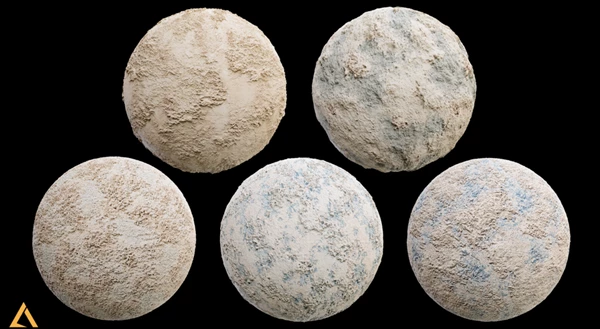
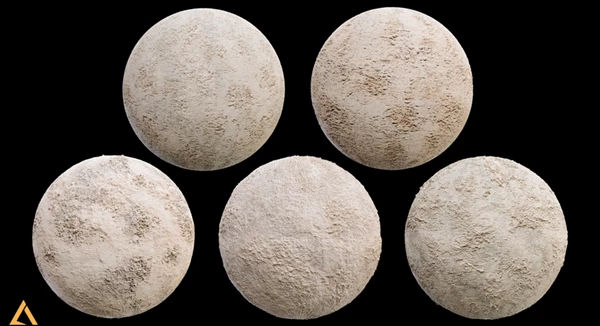
High-Quality Material Previews
The package also includes high-quality previews, allowing you to see the appearance of the materials before deciding which one fits a particular object or scene.
When working with a collection containing dozens of surfaces, clear previews can make material selection considerably faster.
Where Can You Use These Materials?
The collection can fit into many types of 3D projects.
In an architectural visualization, for example, you could use plaster materials for interior walls while applying concrete variations to floors, structural columns, exterior walls, or unfinished architectural elements.
For game environments, the materials can help texture buildings, tunnels, abandoned structures, industrial locations, urban environments, and other large surfaces.
They can also be useful for digital art and rendered scenes, where concrete or plaster serves as a background or supporting surface around the main subject.
Since the textures are tileable, they are particularly practical when working with large environmental assets.
Tips for More Realistic Results
Having detailed materials is a strong starting point, but the way they are applied also has a major impact on the final result.
Adjust Texture Scale Carefully
Pay attention to the physical scale of the texture.
Concrete pores and plaster details that appear believable on a small object may look unnaturally large when applied to an entire building. Compare the texture details with recognizable objects in the scene to establish a believable scale.
Avoid Excessive Height
Height information can add convincing surface depth, but stronger displacement does not automatically produce a more realistic result.
For relatively smooth plaster or concrete, subtle height variation is often enough. Adjust the intensity according to the type of surface and the distance from which it will be viewed.
Let Roughness Work With Your Lighting
Roughness becomes much easier to evaluate under suitable lighting.
Rotate your lights or environment and observe how highlights move across the material. This can reveal subtle roughness variation that may not be obvious under flat illumination.
Break Up Large Repeating Areas
Even seamless materials can reveal repetition when used across extremely large surfaces.
Depending on your software and workflow, consider introducing additional variation through material parameters, masks, decals, vertex painting, or other texture layers. Small differences in dirt, color, damage, or roughness can make large environments feel less repetitive.
Match the Material to the Scene
Not every concrete or plaster surface needs the same amount of visual detail.
A clean modern interior may benefit from subtle variations, while an older environment can support stronger imperfections and surface changes. Choose and adjust the material according to the story and condition of the object rather than adding detail simply because it is available.
A Practical Material Library for 3D Work
60 Plaster and Concrete Base Materials provides a useful combination of variety, resolution, and workflow flexibility for artists who frequently work with architectural and environmental surfaces.
With 60 SBSAR materials, 4K PBR texture maps, seamless tiling, and high-quality previews, the collection can reduce the amount of time spent building common plaster and concrete surfaces from the beginning.
The materials are also flexible, so you don’t have to use them with one specific look. You can change the scale, depth, roughness, and other details to better match your scene.
This makes them useful for many types of projects, including architectural renders, game environments, digital art, and other 3D work.

Files Password : gfxplugin.com OR 123456